Generative UI: The Interface That Shapes Itself Around You
In recent years, we have witnessed an extraordinary evolution in language models. But the real turning point is happening now: artificial intelligence is no longer just generating content, but rather interfaces, tools, and dynamic layouts, instantly designed to respond to a specific purpose.
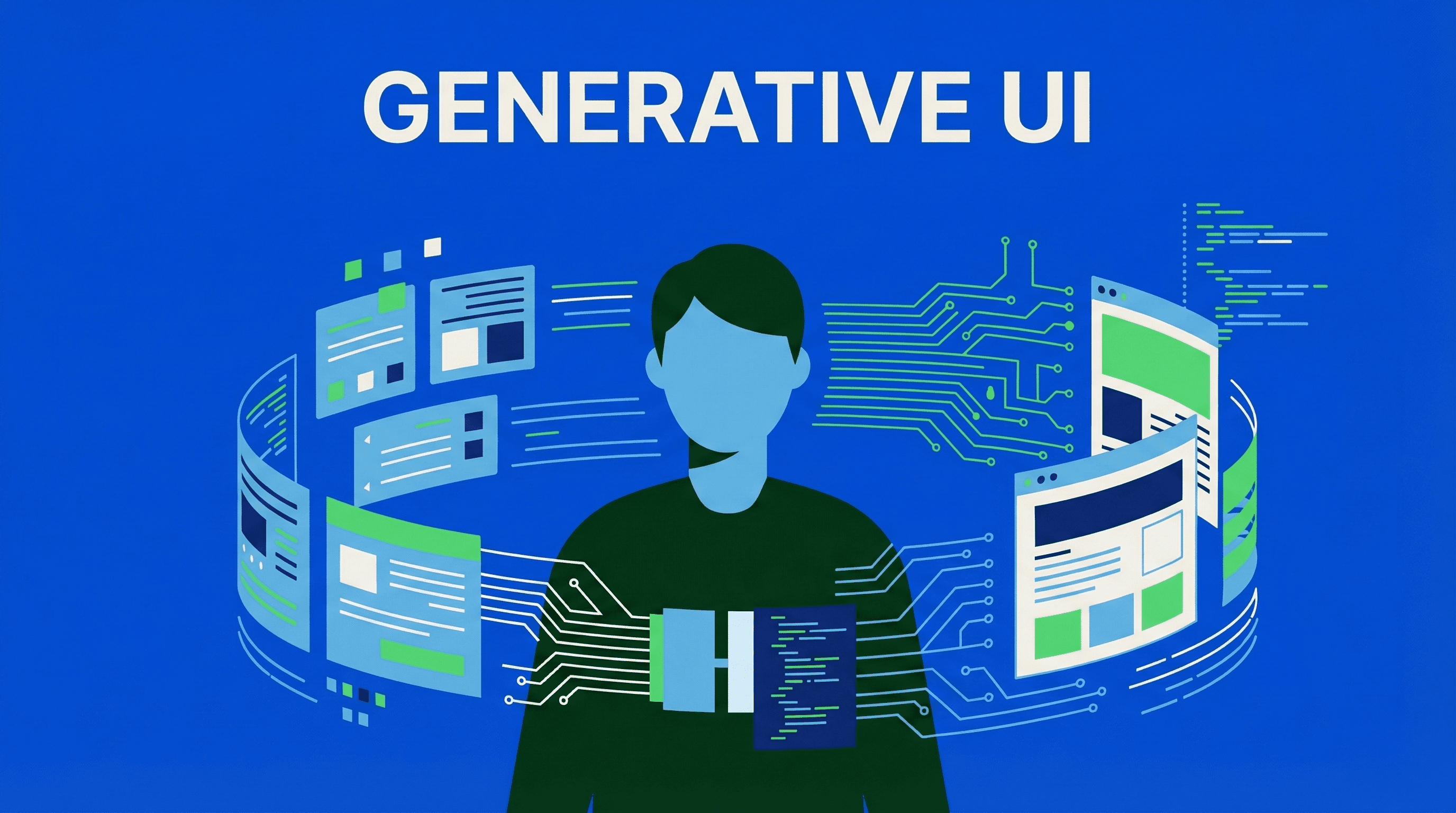
Google is demonstrating this with its most radical vision: Generative UI. This isn't just an evolved version of chat, but a new model of experience. With Visual Layout and Dynamic View, AI responses become visual pages, editorial layouts, interactive forms, and personalized mini-apps built on the fly based on the user's prompt.
Google isn't just generating content; it is designing actual on-demand digital tools. A search can transform into an interactive map, an itinerary, an educational app, or an explorational gallery. This represents a distinct break from the past.
The Role of the Widget Catalog (and Why It’s Revolutionary)
Google is building Generative UI upon a component system called the Widget Catalog. It is not a marketplace, it is not a package of templates, and it is not a static set of ready-made UIs. It is something far more interesting:
The AI chooses and combines predefined UI components (buttons, lists, maps, cards, sliders, tabs) to build interfaces that are reliable and consistent with the brand.
The Widget Catalog:
Gives the AI a repertoire of elements.
Maintains visual consistency.
Guarantees robustness and usability.
Leaves the AI full freedom to generate new combinations and layouts.
This is a strategic shift. Google doesn't let the AI invent arbitrary UIs; it generates them by composing certified elements governed by brand rules. With the Flutter SDK, developers and companies can even define their own widget catalog, making the generated UIs consistent with their existing design systems.
In practice:
The designer no longer designs every single screen.
Instead, they design the rules by which the screens are generated.
It is the shift from interface design to experience meta-design.
Multimodality is the New Grammar of UX
This paradigm isn't limited to Google. Other Big Tech companies are converging on a single interaction model:
OpenAI combines interactive UI and autonomous agents: the assistant can use tools, show inline graphical components, and speak via multimodal models like GPT-4o.
Meta pushes Generative UI beyond the screen with smart glasses: you simply look at something and ask a question to get visual and vocal interpretations in real-time.
Microsoft transforms every piece of software into a conversational environment: you no longer navigate menus; you ask for what you want, and Copilot does it.
Amazon brings Generative UI to the smart home: Alexa+ orchestrates multi-step actions and generates dynamic layouts on Echo Show screens.
The direction is clear: voice, text, images, tools, and agents coexist within the same experience.
Concrete Examples Already in Reality
A request to Gemini generates a personalized interface with images and navigable cards without writing a single line of code.
With Meta AI, simply looking at an object with smart glasses provides a contextual interpretation spoken aloud.
With Copilot, you can build a complete app by describing it in natural language.
Alexa+ can handle an entire process (finding a recipe, listing ingredients, setting reminders, and purchasing) with a single voice request.
These are not concepts: they are products already rolling out.
Why This is a Strategic Shift
Generative UI eliminates two historic limitations:
The static interface that is the same for everyone.
The need to learn every system, app, or design difference.
The UI becomes:
Adaptive,
Contextual,
Dynamic,
Personalized,
Built on the fly.
The new interaction is not navigating, but delegating need, context, and intention.
Vision: The Future No Longer Has “Apps,” But Generated Experiences
Many applications as we know them today will disappear. Not because AI will replace them, but because:
The interface becomes a fluid process, not a product.
The user doesn't choose a tool: the AI builds the best tool for them at that moment.
It is a paradigm shift similar to the transition:
From desktop to mobile.
From mouse and keyboard to touch.
From apps to conversation.
The next leap will be: From pre-designed interfaces to tools generated when needed.
And those designing services will need to think about:
Generative design systems.
Adaptive components.
Autonomous agents.
Multimodality as the natural language of interaction.
The Conclusion is Simple
Generative UI is the beginning of a new software model. Its strength lies not in the technology, but in the experience: adaptive, multimodal, personalized, proactive.
An interface that doesn't impose itself, but molds itself to us. And this is where the real competition between the next digital products will play out.